MOTION INTEGRITY ARCHITECTURE
Motion Integrity Architecture · Panacea Bio Chem
KineticON™
MOTION, PROVEN.
- Deterministic motion control.
- Persistent machine state.
- Open drive architecture.
- COMMAND ACCEPTED
- MOTION ACTIVE
- POSITION SETTLED
- FRAME VERIFIED
- MOTION PROVEN
KineticON™ · THE MACHINE KNOWS.
In one paragraph
KineticON™ is Panacea Bio Chem’s motion-control architecture, invented by Bogdan Dicoias while building the PleniDose laboratory gantry. It combines a deterministic controller, a real-time drive network and a developer platform, and it adds what conventional controllers leave to the application engineer: every important move is a persistent transaction with a receipt (MotionProof), every coordinate frame has an identity and a history (FrameProof), every position is returned with its provenance (StateWitness), and every axis is continuously compared with the way it behaved yesterday (ShadowTwin). The machine builder chooses the motors. The machine belongs to its owner. And the controller solves controller problems.
The problem
Your machine is yours. The truth about its motion is not.
The mechanics are yours. The process is yours. The software and the intellectual property are yours. And underneath all of it sits a box somebody else built, speaking a protocol somebody else decided you may only partly see.
When the communication link drops mid-move, the application engineer has to work out whether the motion happened. When the PC crashes, the application engineer reconstructs physical truth. When a coordinate frame becomes questionable, the application engineer invents trust semantics. When a vertical axis has a brake, the application engineer makes sure it stops before the brake closes. When the motor is warm while standing still, the application engineer goes looking for the reason.
This is backwards. The controller should solve controller problems. The machine builder should be building the machine.
- DID IT RECEIVE THE MOVE?MotionProof records RECEIVED, VALIDATED and ACCEPTED with a command hash — before anything moves.
- DID IT START? DID IT FINISH?Every transition to TRANSACTION COMPLETE is persisted inside the controller, with the final encoder result.
- WHAT HAPPENED WHEN THE LINK DROPPED?The controller kept owning the motion. The PC reconnects and asks for the receipt — no silent replay, no duplicate execution.
- IS THE FRAME STILL VALID?FrameProof knows what invalidates it: power loss, discontinuity, a replaced holder. A reconnect is not one of them.
- WHY IS THE MOTOR HOT WHILE IDLE?QuietHold matches holding current to the measured load — and never lowers it on a vertical axis without a proven brake.

Why KineticON exists
I STOPPED WORKING AROUND THE CONTROLLER.
“KineticON started because I got tired of paying extraordinary money for motion-control hardware only to discover that the machine builder was still expected to solve the hardest problems around it.
I could design the machine, write the software, understand the process and know exactly what I wanted the mechanism to do — and yet somewhere underneath everything was still somebody else’s black box, somebody else’s protocol, somebody else’s limitations and somebody else’s idea of what I was allowed to know.
Eventually I stopped asking how to work around it. I asked a different question: if I already know what I want a motion controller to do, why don’t I build the motion controller I actually want?
So I took the matter into my own hands. KineticON is the answer.
I don’t want another controller that merely moves an axis. I want a controller that knows what it was told to do, knows what actually happened, knows whether the machine can still trust its own position, understands the mechanics connected to it, and tells the engineer the truth when something changes.
If that means breaking the conventional shape of a motion controller, then we break the mould.”
— Bogdan DicoiasPanacea Bio Chem
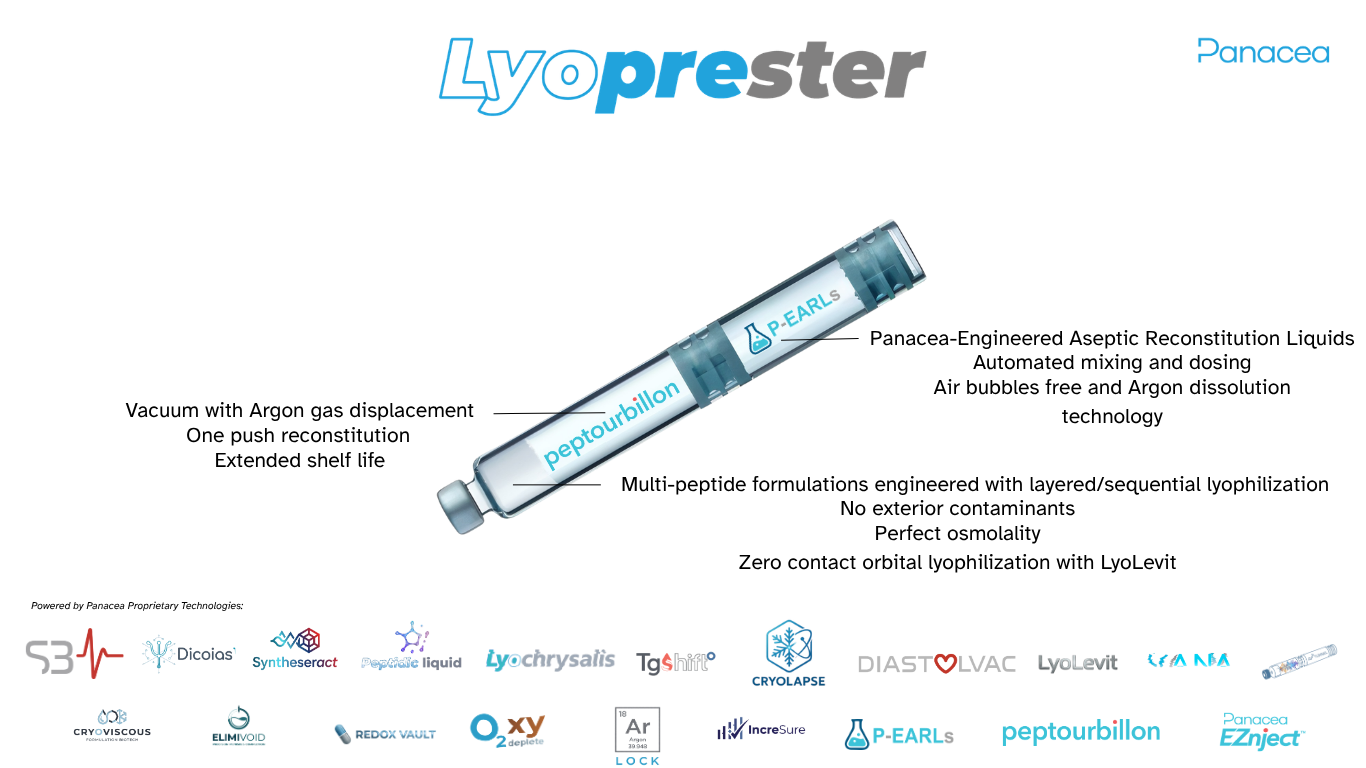
Panacea builds difficult machines. Difficult machines expose the weaknesses of conventional tools. Instead of engineering around those weaknesses forever, Bogdan builds the missing technology — the same pattern behind Lyoprester, S3Pulse and PleniDose.
The architecture
Study the strongest thing each of them does. Then build what nobody combined.
KineticON is not a prettier controller or a cheaper clone. It is a deterministic controller, a real-time drive network, a servo and closed-loop stepper ecosystem, a safety architecture — and the layer the industry left to you: machine-state integrity, persistent motion provenance, commissioning intelligence, condition intelligence and geometry awareness.
MotionProof
Important motion is a transaction with a persisted history. If the PC disappears halfway, the controller still knows what happened.
Every motion has a history → Frame identityFrameProof
Machine, home, work, holder, fixture, tool and product frames with versions, evidence and a dependency graph.
See what breaks trust → ProvenanceStateWitness
Not just Z = 84.650 mm, but which sensor said so, when, in which frame, and whether it is VERIFIED, KNOWN, SUSPECT or UNKNOWN.
Values with provenance → Expected vs actualShadowTwin
A real-time expected-state twin that notices deterioration long before an ordinary fault threshold is crossed.
When the machine no longer feels like itself → CharacterisationAxisDNA & AutoDynamics
Commissioning as science: backlash, friction, resonance, settling and brake timing measured, stored with raw evidence, turned into compensation.
Measure the mechanism → Thermal intelligenceQuietHold
A stationary machine should not cook itself. Holding strategy follows load, brake state and orientation — integrity first.
Cooler at rest → GeometryToolSafe
Envelopes, tools, fixtures, holders and swept volumes. Trajectories are validated before they execute.
Refuse the idiotic move → Hardware eventsProcessSync & TimeFabric
Fire lasers, dispensers, cameras and valves from measured position in FPGA fabric, on one hardware time base.
Position, not a timer → ExecutionControlGraph & Motion Capsule
Declarative, statically checked action graphs and signed local programs that the controller validates and owns.
Checked before it runs →Principles
Ownership of the machine includes ownership of its control architecture.
The builder chooses the motor
AC and BLDC servo, stepper, closed-loop stepper, linear, torque, voice coil and direct drive — with ABZ, Sin/Cos, resolver, SSI, BiSS-C, EnDat and Hiperface DSL feedback.
Local first, always
No compulsory cloud and no mandatory subscription. Remote services may be offered; they never own the machine.
No artificial scarcity
Premium engineering without arbitrary premium friction: no licence demanded for a basic filter or an extra API language.
Documentation for adults
Protocols, state machines, timing and error semantics published. If something has a limitation, the limitation is documented.
Biotechnology & the laboratory
Pharmaceutical and peptide automation, precision dispensing, lyophilisation, synthesis and scientific instrumentation — the machines Panacea builds.
Every precise machine
Semiconductor handling, metrology, optics and laser processing, analytical equipment, inspection, packaging, CNC and robotics — Cartesian to hexapod, with user-defined kinematics.
Biotech — and not only
A problem found in biotech. A technology useful everywhere motion must be true.
KineticON came out of Panacea’s own machines, and it keeps their standard: in a pharmaceutical workflow a move that “probably happened” is not good enough. That same standard is exactly what a wafer stage, a laser cell or a five-axis machine needs.
It is one part of a much wider Panacea engineering ecosystem. KineticON’s autonomy philosophy is shared with S3Pulse, the lyophilisation process-control system; its hardware and process integration with DiastolVAC and Cryolapse; its future in automated synthesis machinery with Syntheseract and CFSPPS. The whole map lives at Panacea Universe.
Origin application
Every KineticON subsystem answers something PleniDose went through.
PleniDose is Panacea’s dosing and crimping gantry for Lyoprester cartridges. Building it meant living with a commodity controller: a link that dropped mid-move, a position read back from a buffer that was never written, fifteen interface elements contending for one library, a Z brake that had to be protected from the software that commanded it. KineticON is the list of those lessons, turned into architecture.
Read the case- A link drop mid-move → MotionProof & LinkPulse
- A failed read reported as a position → StateWitness: unknown is never a number
- A frame re-anchored on a wrong assumption → FrameProof
- A brake that must not close on a moving axis → the safe brake primitive
- A warm idle machine → QuietHold
- Widgets polling one controller → EventStream
Glossary
The words KineticON uses precisely
Deterministic motion
- Motion whose timing is bounded and repeatable by design: the servo and trajectory cycles run on dedicated real-time cores or FPGA fabric, never on a general-purpose operating system.
Transaction
- A motion command with an identity and a persisted life-cycle, from RECEIVED to TRANSACTION COMPLETE, that the controller can report after any interruption.
Frame trust
- The deterministic state of a coordinate frame — VERIFIED, KNOWN, SUSPECT or UNKNOWN — derived from evidence, not an AI probability.
EtherCAT
- The open real-time Ethernet fieldbus standardised as IEC 61158, whose distributed clocks synchronise drives to well under a microsecond. KineticON uses it as a first-class open drive network.
Frequently asked
Frequently asked questions
What is KineticON?
Why does the name end in ON?
How is KineticON different from a conventional motion controller?
What happens if the PC crashes during a move?
Is KineticON only for biotechnology?
Which motors and drives does KineticON support?
Does KineticON need the cloud or a subscription?
Who invented KineticON?
References
Sources
- EtherCAT Technology Group — EtherCAT technology and distributed clocks
- EtherCAT — Wikipedia
- Motion control — Wikipedia
- Digital twin — Wikipedia
- Automated Biomedical Research Laboratories: Development, Current State, and a Roadmap — J Biomol Tech, 2026
- The engineering benchmarks behind KineticON, each with its vendor source: State of the art.
Current literature
Trending in the field
Recent developments in the field — refreshed 2026-11-15 by Panacea Bio Chem.
- A Three-Stage Voltage Adjustment Method for Correcting the Inconsistent Action of the Inchworm Piezoelectric Structure — PubMed, 2026 Nov 9
- Adaptive High-Order Sliding Mode Differentiator for Velocity Estimation from Quantized Position Measurements at Ultra-Low Speeds — PubMed, 2026 Oct 22
- Passive rotational substrate handling in three-axis gantry robots — PubMed, 2026 Dec
- Analytical performance and workflow impact of the FASTinov QUICKprep kit for direct bacterial identification and antimicrobial susceptibility testing from positive blood cultures — PubMed, 2026 Nov 11
Weekly review — 16–22 Nov 2026
Publications indexed in PubMed in the last 30 days for precision motion control and laboratory automation — refreshed weekly.
- Automated Perovskite Film Fabrication with High-Resolution Data Acquisition and Machine Learning Analysis — ACS nano, 2026 Nov 10
- Artificial intelligence in the in vitro fertilization laboratory: A scoping review and SWOT-based evaluation of emerging applications — Clinical and experimental reproductive medicine, 2026 Nov 10
- Finite-time robust motion control of intelligent vehicles based on neural approximation and disturbance estimation — PloS one, 2026
- A conceptual framework integrating artificial intelligence with failure mode and effects analysis for diagnostic error reduction in anatomical pathology — Diagnostic pathology, 2026 Aug 7